
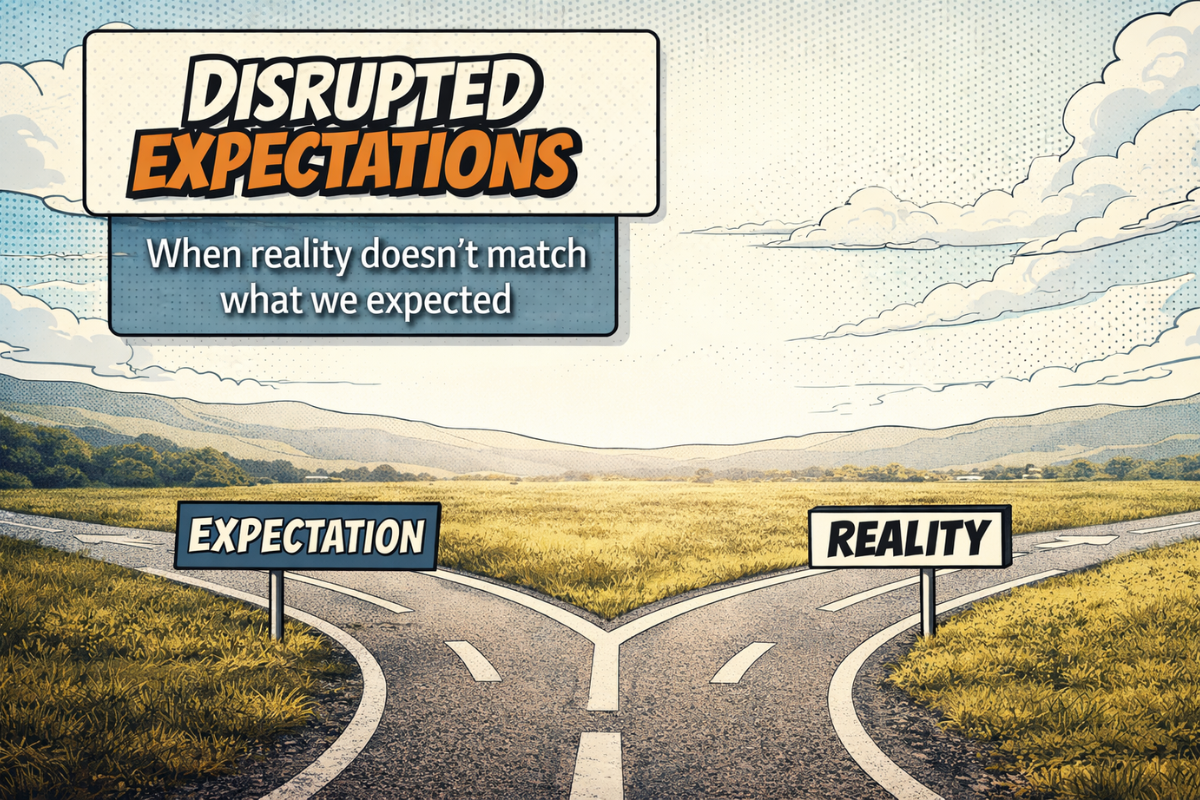
Disrupted Expectations: The Moments That Shape Our Response
Sometimes it’s not what happened that throws us off…
it’s that it didn’t happen the way we expected.
I recently delivered a workshop at a blood donor centre on a topic called Difficult Donors.
In the room were donor staff and their manager — people who show up every day to support others, often in emotional moments.
One of the key challenges they shared was how uncomfortable it can feel when they have to turn a donor away.
From the donor’s perspective, they’ve made the effort to come in, they’re ready to help, and then suddenly… they’re told no.
That moment — right there — is a disrupted expectation.
And as we spoke about it, you could feel a shift in the room.
Not because the situation changed.
But because the understanding did.
What is a disrupted expectation?
At its simplest: A disrupted expectation is when reality doesn’t match what we expected.
It sounds simple.
But it shows up everywhere.
And it often carries emotion with it.
Where this shows up in everyday life
You don’t need to be in a blood donor centre to experience this.
It happens all the time.
A colleague reacts differently than you thought they would
A child doesn’t listen after you’ve clearly explained something
A patient or client responds in a way you didn’t expect
An umpire makes a call that doesn’t go your way
In each of these moments, there’s a gap between what we expected… and what actually happened.
And it’s in that gap where emotion lives.
Frustration.
Confusion.
Disappointment.
Sometimes even anger.
Why these moments matter more than we think
The disrupted expectation itself isn’t the problem.
Our reaction to it is.
Most of the time, we don’t realise what’s just happened.
We go straight into:
reaction
judgement
assumption
And before we know it, a small moment turns into a bigger one.
A moment that caught me off guard
I remember taking my son to his community kinder.
We’d been told his kinder day was still going ahead, even though there were talks of a curriculum day at the deaf school.
I drove him there after an appointment, got to the door… and was met with a confused staff member.
“Why are you here?”
Turns out, the kinder was open for community kids, but not for the deaf and hard-of-hearing children, as their teachers weren’t present.
Expectation: Kinder is on.
Reality: Kinder is not on.
Disrupted expectation.
It threw the day off.
It created confusion.
But after a moment to pause, I was able to reframe it.
We turned it into a dad-and-son day.
Caught up with my wife for lunch.
Went for a bike ride.
Slowed things down.
Same situation.
Different response.
So, what can we actually do in these moments?
Here are three simple tools you can use straight away.
1. Your first word should be a breath
Before reacting… pause.
Even just for a second.
That breath creates space between what just happened… and how you respond
It’s small.
But it changes everything.
2. Choose curiosity over judgement
Instead of:
“Why would they do that?”
“That makes no sense”
Try:
“What might be going on here?”
“What am I missing?”
Curiosity lowers emotion.
Judgement fuels it.
3. Reframe the situation
Ask yourself:
“Is there another way to look at this?”
Sometimes there is.
Sometimes there isn’t.
But even asking the question helps shift your mindset.
Just like that day with my son — the situation didn’t change, but the outcome did.
Why this matters
Disrupted expectations happen to everyone.
Every day.
In small moments.
In big moments.
At work.
At home.
In sport.
In life.
We can’t control when they happen.
But we can control how we respond.
And often, that response shapes everything that comes next.
A reflective pause
When was the last time your expectations were disrupted?
What did you do in that moment?
And what would have changed if you had paused, got curious, or looked at it differently?
If you feel comfortable, share your experience, you never know who it might help.
Emotional Intelligence Isn’t Magic. It’s Trainable.
Emotional intelligence often gets talked about like it’s a personality trait, something you’re either born with or not.
It’s not.
Emotional intelligence (EQ), communication, resilience, motivation, these are learned skills. They grow the same way physical strength does: with reps.
No one walks into the gym and deadlifts 100kg on day one.
No one picks up a guitar and plays a full song perfectly the first try.
Yet people walk into a difficult conversation and expect it to go smoothly, even if they’ve never practised how to:
regulate emotion
listen properly
challenge respectfully
communicate clearly under pressure
That expectation sets people up to fail.
Human skills need the same respect we give “hard skills.”
They need time, repetition, feedback, failure, and a growth mindset.
So what does emotional intelligence actually mean?
At its core, emotional intelligence is the ability to:
recognise what you’re feeling
understand how it’s influencing your behaviour
manage it well enough to respond rather than react
It’s not about being calm all the time.
It’s about noticing what’s happening before things escalate.
What’s the most basic element of emotional intelligence?
Awareness.
Before regulation.
Before empathy.
Before communication.
Awareness of:
your tone
your body language
your internal state
the impact you’re having on others
If you don’t notice it, you can’t change it.
What does emotional intelligence look like in real life?
Let’s make this practical.
For tradies
A job is behind schedule. Pressure’s high. Tempers are short.
Low EQ looks like snapping, blaming, or shutting down communication.
High EQ looks like recognising frustration early and saying:
“I’m getting frustrated here, let’s slow this down so we don’t miss something.”
That one sentence can prevent mistakes, rework, safety issues, and damaged working relationships.
For childcare educators
You’re managing children, families, routines, regulations all while running on limited energy.
Low EQ looks like bottling stress until burnout hits.
High EQ looks like noticing overwhelm early and asking for support before it spills into interactions with children or colleagues.
That protects relationships and wellbeing.
For healthcare workers
High-stakes environments. Emotionally charged situations. No pause button.
Low EQ isn’t about being a bad clinician, it’s about being human under pressure.
High EQ is recognising when stress is driving your responses and grounding yourself, so communication stays clear, calm, and safe.
That skill can change outcomes for patients, families, and teams.
For sporting clubs
Games are intense. Emotions run high. Decisions happen fast, often in front of teammates, opponents, umpires, and supporters.
Low EQ shows up as:
blowing up at an umpire
snapping at teammates
carrying frustration into the next play
letting one mistake spiral into many
High EQ looks like:
recognising the emotional spike and resetting quickly
refocusing on the next contest instead of the last mistake
communicating calmly with teammates under pressure
modelling composure, especially when others are watching
In club environments, emotional intelligence doesn’t just affect performance, it shapes culture.
Players with strong human skills help create teams that stay connected when things aren’t going well, support each other through losses, and hold standards without tearing each other down.
That’s leadership, whether you wear the captain’s armband or not
Why this matters across every industry?
Most people don’t struggle with the technical parts of their job.
They struggle with the human parts.
And yet, we rarely practise them.
We don’t rehearse difficult conversations.
We don’t train emotional regulation.
We don’t normalise feedback on communication.
Then we wonder why things fall apart under pressure.
You’re allowed to get it wrong.
You’re expected to get it wrong.
You just need to keep trying, with intention.
That’s how emotional intelligence is built.
A question worth sitting with
If emotional intelligence were trained the same way technical skills are in your industry…
What would improve first?
Safety?
Communication?
Culture?
Wellbeing?
A Different Way to Think About the New Year
In this blog I felt like a good opportunity to pause, not to reinvent anything, but to offer a slightly different perspective as we head into a new year.
My goal with these blogs has never been to reinvent the wheel for you. I’m not here to tell you what to do or how to live your life. I’m simply offering another way of looking at things.
If one idea, one sentence, or one reflection helps you improve even one aspect of your life or communication that’s a win for me.
Looking Ahead Without the Pressure
I’ve never been a big fan of New Year’s resolutions.
Not because goals are bad, but because so often they’re framed in a way that sets people up to feel stuck or disappointed when motivation fades.
Instead of focusing on what you want to achieve this year, I’ve been thinking more about who you want to become.
For example, someone might say they want to run a marathon. They train, they complete it, and then what?
But if that same person sees themselves as a runner, the marathon becomes part of a longer story. They keep running, improving, and finding new challenges because it’s now part of their identity.
The same applies to learning a skill. You might want to play one song on the guitar, but once you do, motivation can disappear. When you see yourself as a musician, you keep showing up, practising, and growing.
This year, I’m more interested in identity than outcomes.
How I’m Approaching the Year Ahead
One thing I’m intentionally leaning into this year is being a bit more active in the social media space.
Not to chase numbers or trends, but to provide value.
I want to help people:
Think a little differently about communication
Recognise and understand their emotions better
Step into leadership, whether that’s at work or at home
Leadership isn’t always a title. Sometimes it’s simply how you show up in a moment.
A Lesson From Community
One of the biggest learnings I’m taking into this year has come from the Skool communities I’ve been part of.
What’s stood out is how powerful learning becomes when it’s shared.
People from all over the world, with different backgrounds and experiences, showing up with curiosity, generosity, and honesty. Human skills are learned best together, through conversation, reflection, and real examples.
That’s shaped how I want to show up this year too.
Choosing to Be a Life Learner
If I had to name the identity I’m leaning into, it would be a life learner.
I enjoy listening to podcasts, reading books, learning from others, and leaning into the knowledge of people around me, especially within my community.
The real value for me is then taking what I learn and simplifying it.
Breaking it down.
Making it practical.
Making it easy to digest.
So, you don’t have to do all the research yourself.
A Note on Confidence (Because It Matters)
Confidence is something people often tell me they want more of.
But confidence isn’t something you wake up with one day.
It’s built after action.
Confidence comes from:
Setting a boundary; even when it feels uncomfortable
Having one difficult conversation
Speaking up once when you normally wouldn’t
It’s the accumulation of small, uncomfortable moments, repeated over time.
That’s why my goal across all my platforms is to offer simple, practical tasks, small enough to try, real enough to matter.
If you take those micro-opportunities throughout the year, confidence builds quietly in the background.
One Word I’m Carrying Forward
I was asked recently what one word I’d use to describe my goal for the year.
The word I chose was meaningful.
I want to connect with as many people as I can in meaningful ways, whether that’s sharing a laugh, building new relationships, or exchanging experiences and ideas.
That’s what matters to me.
A Gentle Invitation
As you step into this year, maybe ask yourself:
Who do I want to become?
What identity do I want to lean into?
What’s one small action that reflects that?
You don’t need to overhaul your life.
You just need to start and give something.
A Moment to Pause, Reflect, and Say Thank You
Pause Reflect and Thank-You
As the year comes to a close, I wanted to take a moment to slow things down.
Not to rush into goals, plans, or big declarations for next year, but to pause and reflect on what’s already happened.
If you’ve stopped by and read one of my blogs this year, thank you.
Truly. It means more than you probably realise.
If something I’ve written resonated with you and you’ve shared it with someone else, that means the world to me. These reflections only matter if they help someone pause, think, or feel a little more connected.
So before the year wraps up, here’s a look back at the wins, the learnings, and what I’m carrying forward.
The Wins Worth Noticing
This year, I created Dan Hall Co, something that started as a quiet idea and slowly became real.
I was fortunate to deliver Human Skills workshops to over 250 people across the Melbourne area, creating space for conversations around communication, emotional intelligence, leadership, and connection. Seeing people pause mid-session, reflect, and have those “ah-huh” moments never gets old. That’s the part of the work that lights me up.
One moment that made me especially proud happened during an Emerging Leaders Day.
While I was introducing the session, a young nurse raised her hand and said, very honestly:
“I don’t think I should be here. I’m not a leader.”
I walked over and asked her a simple question.
“When a patient deteriorates in your care and you press the alarm for help, and everyone arrives… who do they turn to first?”
She paused.
Then, a little sheepishly, she replied,
“Me?”
I smiled and said,
“So in that moment, you were the leader.”
“I guess so?”
“So why wouldn’t today be for you? You’re exactly the person who should be here.”
Her face lit up.
From that moment on, she flourished. She leaned into the activities, contributed openly, and genuinely enjoyed the day. At the end, she came up to thank me for what she called the “pep talk.”
It was a reminder that so many people are already leading, quietly and responsibly, without ever being told they are.
Leadership isn’t always loud.
Sometimes it’s simply being the one people turn to when it matters.
Another highlight this year was working with an electrician who initially struggled to see the value in so-called “soft skills.” Over time, that shifted. He began noticing his emotional responses, communicating more clearly, and even improving how he showed up at home with his wife, kids, and colleagues. Watching skills transfer from work into real life is incredibly rewarding.
I also created a Skool community, bringing together people from around the world who care about connection, communication, and growth. Slowly and intentionally, we’re building a culture focused on one simple idea: Make Human Skills Matter.
The Learnings That Shaped Me
Creating your own business is hard work.
All the little things you don’t think about at the start show up very quickly. Systems, structure, energy, doubt, it all becomes real. But it’s also been one of the most rewarding experiences of my career. I’ve developed skills I never expected to need, and I’ve loved every minute of it, especially witnessing those “ah-huh” moments in clients and audiences.
Motivation hasn’t always been easy.
Some days, starting a draft email felt like a win. Some days, even opening the laptop, or getting out of bed took effort. What I’ve learned is that making tasks smaller matters. One sentence. One action. One ticked box. Most of the time, that small step creates momentum. And even when it doesn’t, it still counts.
Consistency hasn’t meant giving 100% every day.
There were days where I only had 20% to give, and that’s okay. Being human means some days are lighter than others. Doing one thing is still progress. It’s one less thing for tomorrow. Showing up a little each day accumulates into something far bigger over time, you just have to start.
The Support That Carried Me Through
I’d be remiss not to acknowledge the person who supported me most when things felt heavy.
My wife, Nicole.
Over the past 12 months, she has been there in every way, reading drafts of my posts, offering encouragement, grounding me when doubt crept in, and putting up with me on days when life felt tough.
Like most families, we’ve been tested at times while balancing kids, work, business, family life, and our dogs. It hasn’t always been smooth. But we’ve worked through it together.
Her support has been steady, honest, and deeply human and I’m incredibly grateful.
Thank you, honey. I love you.
Looking Ahead to What Matters Most
Next year, my biggest goal is more family time.
I’ve reshaped both my nursing work and my business so I can be more present at home. I once had a senior colleague tell me his kids remembered him always working, and that stayed with me.
I don’t want that for my kids.
I want them to remember morning coffees before school,. days at the footy, ice-cream dates, the good stuff.
At the same time, Making Human Skills Matter remains something I’m deeply passionate about.
Since COVID, many of us have become more inward. More hesitant. More worried about saying the wrong thing. But relationships don’t grow without curiosity. Connection doesn’t happen if we don’t feel comfortable asking a question.
And yes, that includes you reading this now.
I want to build a relationship with you. To share moments, reflections, lessons, and stories that help us all show up a little more human, at work, at home, and everywhere in between.
A Gentle Invitation to Reflect
Before the year ends, maybe pause and ask yourself:
What’s one win from this year you haven’t acknowledged yet?
What challenged you but helped you grow?
Where did you show up, even when it was hard?
What do you want the people closest to you to remember about this season of your life?
You don’t need perfect answers.
Honest ones are enough.
Thank you for being here.
Thank you for reading.
And if you think this might resonate with someone else, feel free to share it with them.