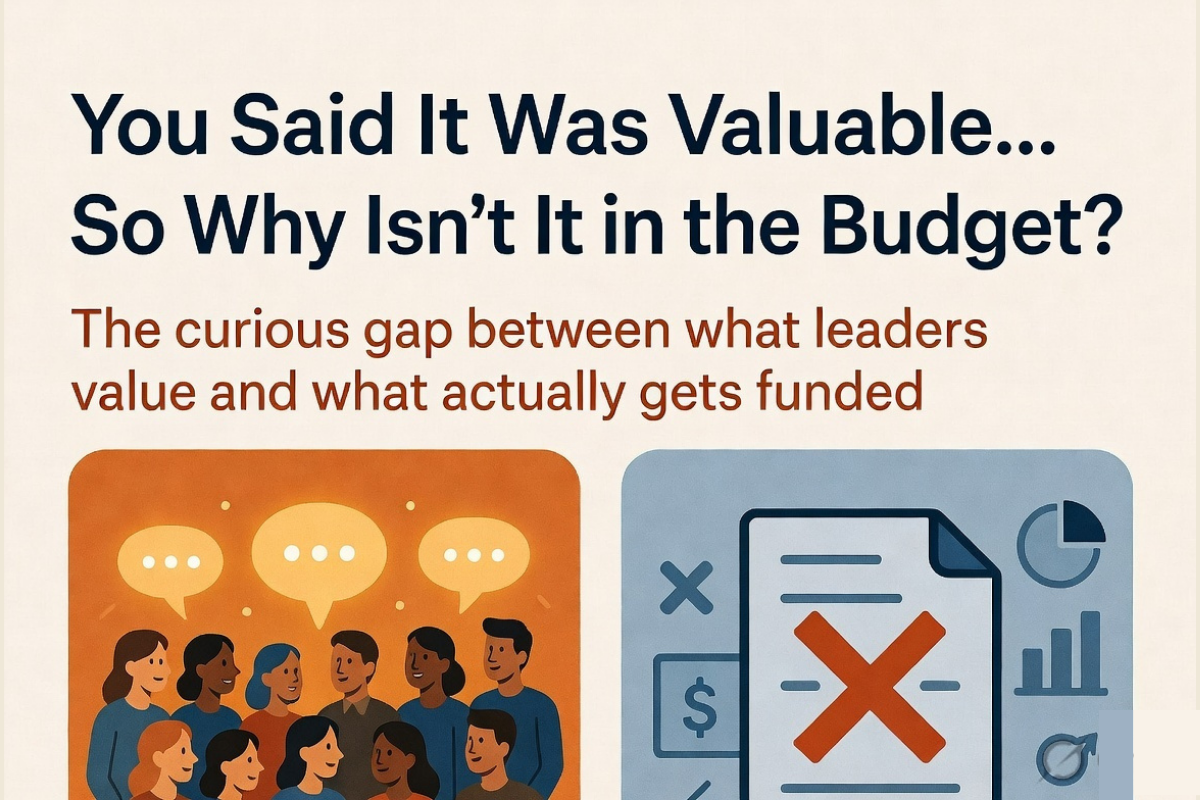
You Said It Was Valuable. So Why Isn't It in the Budget?
There's a conversation I've had more times than I can count.
I reach out to a business. We talk about their team — the pressure people are under, the communication challenges, the moments where things quietly fall apart. I explain what I do: working with leaders and teams on the human skills that hold everything together. Emotional intelligence. Conflict management. Feedback. Resilience. Psychological safety.
They nod along. Sometimes they say, "This is exactly what we need."
And then: "We just don't have the budget for it."
Here's the thing that gets me every time.
I haven't even told them how much it costs yet.
So Let's Start There
"No budget" is one of the most common responses I hear when speaking with leaders about professional development — specifically around the kind of development that doesn't come with a neat KPI attached to it.
It's not a new problem. But it's one worth looking at more closely, because the gap between "we value this" and "we'll fund this" says a lot about how organisations think about their people.
When I ask whether the sessions I run would be of value to their team — almost everyone says yes. Without hesitation. They can see the benefit. They understand, on some level, that helping their staff with emotional regulation, or how to navigate conflict, or how to give and receive feedback without it derailing a relationship — these things matter.
But value and budget are apparently two different conversations.
Where Does the Ad Hoc Money Come From?
Here's a question I find genuinely curious: what happens when something goes wrong that wasn't in the budget?
A team member resigns unexpectedly. A conflict escalates and HR needs to be involved. Someone goes on extended leave and the remaining staff are stretched thin. A client makes a complaint that requires investigation.
Somehow, money appears. It gets found. Because it has to.
The investment required to address a crisis has never been a budgeted line item — but it gets funded because the cost of not funding it is immediately visible.
So why is it that proactive investment — the kind that might have prevented the crisis in the first place — can't find its way into the budget? Is ad hoc support for staff somehow held to a different standard than ad hoc problem-solving?
What's Missing From the Conversation?
If a manager or an executive acknowledges that something is valuable, but doesn't allocate budget to it — what's the gap?
I've thought about this a lot. And I keep coming back to one thing: skills like emotional intelligence, conflict management, feedback resilience, boundary-setting, and psychological safety are rarely tied to a measurable KPI. They don't show up directly on a balance sheet. You can't point to a graph and say, "That improvement happened because we taught people how to navigate a difficult conversation."
But does that make them less real?
Think about the best leader or manager you've ever had. The one who made you feel heard, who held the team together under pressure, who gave feedback in a way that actually made you better. Now ask yourself: how much of what made them great was technical knowledge — and how much of it was the human stuff?
The reason I run sessions on these skills is because I believe that great leadership isn't a personality trait you're either born with or you're not. It's something that can be learned, practised, and developed. The best leaders I've seen become better versions of themselves not because they worked harder, but because they worked smarter on how they show up for their people.
That's worth investing in.
A Question for You
Think about your own workplace for a moment. When was the last time your team had access to genuine support around the skills that make work feel human — not just productive? And if the answer is "not recently" or "never" — where does that sit in the budget conversation?
Part 2 of this post looks at what happens when that investment doesn't come — and why, particularly in Victoria right now, the stakes of getting this wrong are higher than many businesses realise.